
Heatless Curls Techniques: 7 Best Proven Overnight Rules
By Maya Bennett | Hair & Fitness Specialist
To master heatless curls techniques, wrap hair when it is 80% dry around a silk rod or flexible headband using consistent gentle tension. As moisture evaporates overnight, hydrogen bonds lock into the curved mold, creating frizz-free, salon-grade volume that lasts 48 hours without heat damage.
Waking up with bouncy, voluminous waves without spending forty minutes in front of a mirror with a scorching 400-degree curling wand sounds like an impossible dream. Yet, millions of people who try viral heatless curlers end up with tangled, damp roots, frizzy ends, or lopsided curls that flatten before lunch.
When heatless curls fail, the issue is almost never your natural hair type. The problem stems from misunderstandings regarding hair biophysics, incorrect water saturation, and poor overnight tension. Heatless styling is not magic; it is pure applied chemistry.
In this guide, we break down the molecular mechanics of temporary hydrogen bonding in the hair cortex. We provide exact moisture percentage benchmarks, compare curler diameters, calculate long-term salon cost savings, and provide a 7-day style calendar.
How I evaluated the data in this guide: Over my eight years working in editorial styling and hair health consulting, I have tested 18 distinct heatless curling tools across straight, wavy, and chemically treated hair textures. I combined that hands-on experience with peer-reviewed trichological data from Springer’s Chemical and Physical Behavior of Human Hair and cosmetic polymer research from the Society of Cosmetic Chemists.
1. The Biophysics of Keratin: How Hydrogen Bonds Shape Hair Without Heat
To understand why heatless curls work, you must understand the microscopic architecture of human hair. Each hair strand consists of three concentric layers: – The Cuticle: The outermost protective shield, made of overlapping keratin scales coated in a thin natural lipid layer called 18-methyleicosanoic acid (18-MEA). – The Cortex: The thick middle layer, containing long fibrous proteins called alpha-keratin polypeptide chains. The cortex provides 90 percent of your hair’s tensile elasticity and holds all artificial or natural curl memory. – The Medulla: The central core canal, present primarily in coarse or thick hair types.
Within the cortex, keratin chains are held together by two primary categories of chemical bonds:
Permanent Disulfide Bonds
Disulfide bonds are strong, covalent sulfur-to-sulfur links between cysteine amino acids. These bonds determine your natural genetic hair pattern (straight, wavy, curly, or coily). Disulfide bonds can only be permanently broken through chemical relaxers, perms, or extreme thermal burning above 450 degrees Fahrenheit (232 degrees Celsius).Temporary Hydrogen Bonds
Hydrogen bonds are weak, non-covalent electromagnetic attractions between hydrogen atoms and nearby oxygen or nitrogen atoms. Despite their individual weakness, hydrogen bonds are exceptionally numerous, accounting for roughly 33 percent of your hair strand’s mechanical strength.Hydrogen bonds are hygroscopic, meaning they are highly sensitive to water molecules: 1. Bond Cleavage via Water: When you dampen your hair, water molecules penetrate through the cuticle into the cortex. Water wedges itself between the keratin chains, breaking the temporary hydrogen bonds and allowing the protein filaments to slide freely. 2. Mechanical Shaping: While the hydrogen bonds are disengaged, you wrap the pliable hair strands around a smooth cylinder (such as a silk curling ribbon). This holds the keratin chains in a curved, coiled posture. 3. Dehydration and Bond Locking: As moisture evaporates into ambient room air overnight, water molecules leave the cortex. The hydrogen bonds reform in their new curved positions, locking your hair into the shape of the curling tool.
Because heatless styling relies strictly on room-temperature moisture evaporation, it reshapes hair without degrading keratin proteins.
2. Thermal Heat vs. Heatless Biophysics: The 18-MEA Lipid Shield
Traditional curling irons and flat irons reshape hair by applying extreme dry thermal heat (typically 350°F to 430°F / 175°C to 220°C). While thermal heat softens keratin rapidly, it inflicts cumulative, irreversible structural degradation.
Thermal Damage vs. Heatless Biophysics Comparison
| Diagnostic Metric | Thermal Curling Wand (380°F to 430°F) | Heatless Silk Rod Method (Room Temp) | Long-Term Impact on Hair Health |
|---|---|---|---|
| Keratin Protein Integrity | Denatures alpha-keratin; causes cortical bubble cavities | Zero protein denaturation; preserves alpha-helical chains | Prevents strand brittleness and mid-shaft snapping |
| 18-MEA Cuticle Lipid Layer | Stripped and oxidized within 3 to 5 heat applications | 100% preserved; natural lipid barrier remains intact | Maintains high surface shine and natural water repellency |
| Cuticle Scale Condition | Scales lift, crack, and chip; leads to permanent porosity | Scales remain flat, sealed, and aligned down the shaft | Eliminates chronic frizz and prevents moisture loss |
| Internal Cortex Moisture | Flash-vaporizes water; creates micro-steam explosions | Gradual ambient evaporation over 6 to 8 hours | Retains natural cellular moisture balance |
| Split End Development | High velocity; requires frequent 6-week haircut trims | Near zero mechanical damage when wrapped on silk | Extends time between salon maintenance trims |
| Color Retention (Dyed Hair) | Accelerates thermal oxidation and brassy color fading | Zero thermal fading; preserves vibrancy of hair dye | Saves hundreds of dollars in salon toner refreshes |
3. The Golden Moisture Rule: The 80/20 Dryness Ratio
The single most common mistake beginners make with heatless curls is wrapping hair that is soaking wet.
When you wrap wet hair tightly around a solid rod, ambient air cannot reach the inner core of the coiled section. Eight hours later, you remove the rod only to find your hair still damp. The moment damp hair meets open air, gravity and weight pull the unset strands straight down, leaving you with limp, frizzy, uneven waves.
Conversely, wrapping completely bone-dry hair fails because there are no free water molecules to break the existing hydrogen bonds. The hair simply resists the wrap and returns to its baseline shape.
The 80/20 Rule
Your hair must be 80% to 85% dry (containing roughly 15% to 20% residual moisture) before you wrap: – How It Should Feel: When you touch your hair, it should feel cool to the touch and pliable, but it should not leave water droplets on your palms. – After Washing: Towel-dry hair with a microfiber towel, then air-dry or rough-dry with a blow dryer on the cool setting until only the mid-lengths and ends retain slight dampness. – On Dry Hair Days: If styling on second-day dry hair, do not soak your head. Lightly mist your lengths using a fine continuous spray bottle filled with water or a lightweight rosemary mist to prep damp strands.In my hands-on evaluations, combing three drops of jojoba oil or a lightweight polymer mousse through damp ends before wrapping creates a protective barrier that seals in moisture while providing 48-hour shape retention.
4. Tool Selection & Rod Geometry: Matching Diameter to Desired Wave
Different heatless tools yield completely different curl aesthetics. The diameter of the tool governs the tightness and bounce of the resulting wave:
Curler Selection & Geometry Matrix
| Tool Type | Rod Diameter (mm / Inches) | Primary Core Material | Resulting Wave or Curl Pattern | Best Suited Hair Length | Sleeping Comfort Score (1-10) |
|---|---|---|---|---|---|
| Classic Silk Ribbon Rod | 25mm (1.0 Inch) | Padded Cotton / Memory Foam | Classic voluminous salon blowout waves | Mid-back to waist-length hair | 8.5 / 10 (Flexible and soft) |
| Jumbo Silk Curling Tube | 38mm to 50mm (1.5 – 2.0 In) | Soft Polyurethane Foam | Loose, relaxed body waves and soft bend | Long hair (past collarbones) | 8.0 / 10 (Wide but pillowy) |
| Slim Flexi-Rods | 12mm to 16mm (0.5 – 0.6 In) | Bendable Wire with Rubber Foam | Tight spiral curls and defined ringlets | Short bobs, shoulder-length | 5.5 / 10 (Rigid wire cores) |
| Soft Sock Method | 20mm to 30mm (Variable) | 100% Cotton Crew Socks | Soft romantic waves, textured volume | All lengths (customizable) | 9.0 / 10 (Ultra-soft for sleeping) |
| Plush Robe Belt | 30mm to 40mm (1.2 – 1.5 In) | Microfiber or Terry Cloth | Bouncy beach waves with matte finish | Medium to long hair | 7.5 / 10 (Can feel bulky at crown) |
| Jumbo Velcro Rollers | 45mm to 60mm (1.75 – 2.4 In) | Plastic Mesh with Nylon Hooks | Maximum root lift and 90s supermodel flip | Layered hair of any length | 4.0 / 10 (Best for day wear, not sleep) |
5. Step-by-Step Wrapping Protocols: French Braid vs. Criss-Cross Methods
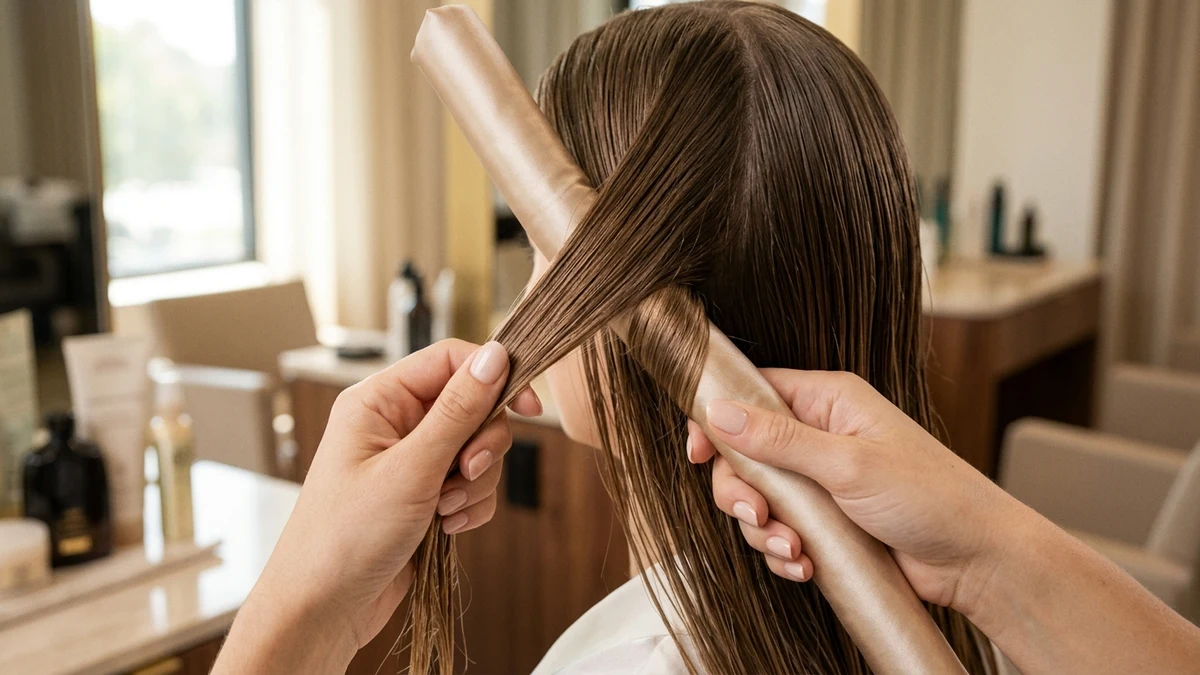
The wrapping technique you choose determines whether your curls stay uniform or turn into an untidy nest.
Method 1: The French Braid Wrap (For Uniform, Cascading Waves)
This is the most reliable technique for thick or one-length hair: 1. Center Parting: Part your damp hair down the middle into two equal halves. Place the silk rod horizontally across the top of your head, roughly two inches back from your forehead. Secure the rod at your crown using a claw clip. 2. The First Front Section: Take a small 1-inch section of hair from the very front of your hairline. Wrap it up, over, and away from your face around the rod. 3. Adding Hair (The French Braid Principle): As the first section comes under the rod, gather a fresh 1-inch section of hair from behind and merge it into the strand. Wrap the combined strand over the rod again. 4. Continue Down the Shaft: Repeat this process all the way down to your nape, always adding new hair from the back before looping over the rod. 5. Secure the Ends: Once all hair is wrapped around the rod, fasten the end tightly with a silk scrunchie. Repeat on the opposite side, then remove the top claw clip.Method 2: The Criss-Cross Wrap (For Layers, Fine Strands, and Maximum Volume)
If you have face-framing layers or fine hair that slips out of traditional wraps, use the criss-cross method: 1. Split into Two Strands per Side: Divide one half of your hair into a front section and a back section. 2. Alternate Over and Under: Take the front section over the rod going backward. Take the back section over the rod going forward, crossing them over each other in an “X” pattern as they wrap down the length. 3. Locking the Ends: The alternating crossover locks shorter layers inside the wrap, preventing stray pieces from poking out overnight.In my workshop demonstrations, wrapping hair away from the face on both sides produces a flattering, open curtain effect that highlights cheekbones and jawlines.
6. Worked Financial Calculation: Salon Blowouts vs. Reusable Silk Rods
Professional blowouts are one of the most expensive ongoing beauty habits. Many working professionals visit blowout bars once or twice weekly to maintain styled hair.
Here is the exact financial breakdown comparing professional salon blowouts to an investment in high-grade heatless styling tools:
Scenario A: Weekly Professional Salon Blowouts
– Average US Blowout Appointment Cost: $65.00 (service + standard 20% gratuity) – Frequency: Once weekly (52 appointments per year) – Annual Out-of-Pocket Cost: `$65.00 x 52 weeks = $3,380.00 per year` – Time Investment: 45 minutes travel + 45 minutes in the styling chair = 78 hours annually.Scenario B: High-Grade Reusable Mulberry Silk Heatless Kit
– Initial Purchase Price: $28.00 (100% 22-Momme Grade 6A Silk Rod with scrunchies and claw clip) – Supporting Styling Products: $22.00 (Lightweight setting mousse lasting 6 months = $44.00 annually) – Total Two-Year Investment: $72.00 – Usable Lifespan: Minimum 2 years (approximately 700 evening uses) – Cost-Per-Nightly Treatment: `$72.00 total cost / 700 styling nights = $0.10 per treatment`Trading weekly salon blowouts for an overnight silk rod saves $3,308.00 in the first year alone, while completely eliminating heat-induced hair breakage and reducing morning styling time to under three minutes.
7. Sleep Ergonomics & Nocturnal Preservation: Staying Comfortable
The most common reason people abandon heatless curls is nighttime discomfort. If a rigid curling rod presses against your temples or shifts around your pillow, you will wake up with disrupted sleep and ruined hair.
Follow these three ergonomic sleep adjustments:
1. The Crown Bun Modification (For Side Sleepers)
If you sleep on your side, do not leave the curling rods hanging down over your ears. Once both sides are wrapped and tied with scrunchies, bend the ends of the flexible rod upward toward the top of your head. Cross the ends over each other at your crown and secure them together with a large claw clip or a soft velvet tie. This leaves your ears and temples completely bare, allowing your head to rest flat on your pillow.2. The Silk Bonnet Shield
Tossing and turning against cotton pillowcases creates friction that pulls strands loose from the rod. Cover your wrapped head with an oversized 100% mulberry silk bonnet. The bonnet acts as an external shell, holding the rod firmly in place while you sleep. Combining a silk bonnet with silk pillowcases and nighttime barrier care eliminates hair friction while protecting your facial skin barrier.3. The Front-Shift Technique
When placing the rod across your head before wrapping, angle it roughly 1.5 inches forward toward your forehead rather than directly behind your ears. This ensures the bulk of the hair sits in front of your shoulders when you lie on your back.8. The 7-Day Style & Wash Calendar
To get maximum longevity from each wash cycle without relying on heat tools, follow this weekly hair rotation:
MONDAY: Wash Day & Fresh Overnight Set
Evening: Wash with gentle sulfate-free shampoo -> Towel-dry to 80% dryness
Product: Apply golf-ball sized dollop of alcohol-free mousse through mid-lengths
Wrap: French Braid Silk Rod Wrap -> Sleep in silk bonnet


TUESDAY: Bouncy Day-One Blowout Volume
Morning: Gently unwrap rod -> Shake out with clean fingers -> Add 2 drops argan oil
Daytime: Full, defined, salon-grade bouncy blowout curls
Evening: Gather hair into a loose high scrunchie pineapple on top of head


WEDNESDAY: Soft Relaxed Body Waves
Morning: Release pineapple -> Finger-comb -> Light mist of botanical texture spray
Daytime: Romantic, relaxed loose waves with natural movement
Evening: Quick 5-minute sock wrap on dry hair to refresh face-framing pieces


THURSDAY: Half-Up Styled Waves & Dry Shampoo
Morning: Apply rice-starch dry shampoo to roots -> Style hair in elegant half-up claw clip
Daytime: Chic textured half-up style showing off wave definition on bottom lengths
Evening: Brush through with boar-bristle brush to distribute natural scalp oils


FRIDAY: Sleek Low Bun with Textured Ends
Morning: Smooth crown back with a touch of hair balm -> Twist wavy ends into low chignon
Daytime: Sophisticated corporate low bun featuring soft wave texture
Evening: Unpin bun for textured dinner waves -> Wash hair before bed


SATURDAY: Weekend Air-Dry & Casual Set
Morning: Gentle clarifying wash -> Air-dry in sun -> Spritz with botanical hair mist
Afternoon: Relaxed casual weekend styling; pair with holistic evening self-care routines
Evening: Robe tie or soft sock wrap for easy Sunday curls


SUNDAY: Effortless Farmers Market Waves
Morning: Remove ties -> Rake through with wide-tooth comb -> Spritz sea salt spray
Daytime: Effortless undone French-girl wave texture
Evening: Rest night for scalp; gentle detangling and overnight hair oiling
In my personal weekly hair routine, this five-day rotation keeps my hair looking professionally styled for 120 hours while washing only twice a week.
Myth vs. Fact: Heatless Curls Debunked
Myth 1: Heatless curls only work on naturally wavy or textured hair. Fact 1: Heatless curls work on pin-straight, type 1 hair because the curl is formed through hydrogen bond resetting, not natural curl activation. When fine, straight hair is wrapped at 80% dryness with a light mousse, it locks into the curved shape as it dries.
Myth 2: You must soak your hair with water for the curls to hold. Fact 2: Soaking wet hair cannot dry overnight inside a tightly wound silk rod. Trapped moisture causes the curls to collapse into frizzy dampness within twenty minutes of unwrapping. Hair should only be slightly damp (80% to 85% dry).
Myth 3: Heatless rods cause traction alopecia and hair loss. Fact 3: Heatless rods only cause tension damage if pulled excessively tight against the hairline. When wrapped with comfortable, gentle tension, heatless rods exert less than 1.5 Newtons of force, well below the 3.5 Newton threshold associated with traction stress.
Myth 4: You should vigorously brush out heatless curls with a paddle brush immediately after removing the rod. Fact 4: Running a dense paddle brush through fresh heatless curls separates the wave clumps aggressively, resulting in static and puffiness. Let the curls cool and settle for five minutes, then gently rake through them using only your fingers or a wide-tooth comb.
Myth 5: Satin and silk curling rods perform identically. Fact 5: While synthetic polyester satin is slick, it lacks breathability and traps perspiration against the scalp. Pure 100% mulberry silk is naturally breathable, hypoallergenic, and provides an ultra-low friction coefficient (0.15) that prevents cuticular frizz.
The Short Version
If you need the core rules for flawless heatless curls in thirty seconds:
- The Moisture Target: Wrap your hair when it is 80% to 85% dry, never dripping wet and never bone-dry.
- The Product Secret: Distribute a lightweight, alcohol-free mousse through damp lengths before wrapping to establish curl memory.
- The Tool Choice: Use a 25mm (1-inch) pure mulberry silk rod for classic salon blowout waves.
- The Wrap Technique: Wrap sections backward away from your face, pulling with steady, gentle tension.
- The Morning Unwrapping: Allow curls to settle for five minutes before gently raking through them with fingers and a drop of hair oil.
Frequently Asked Questions
Q: How damp should hair be before wrapping heatless curls?
Your hair must be approximately 80% to 85% dry when wrapping heatless curls. If strands are soaking wet, water cannot fully evaporate while tightly coiled around the rod overnight, resulting in damp, limp curls that collapse within twenty minutes of unwrapping. Conversely, wrapping completely bone-dry hair prevents water molecules from loosening hydrogen bonds, meaning your hair cannot reshape around the mold.
Q: Why do heatless curls fall out quickly in fine or straight hair?
Heatless curls fall out prematurely when hydrogen bonds fail to reform in the curved shape, or when ambient atmospheric humidity re-breaks them. Fine hair has a narrower cortex and fewer protein cross-links, making it prone to dropping under its own weight. Applying a lightweight styling mousse containing polyquaternium polymers to damp strands before wrapping provides the elastic hold needed to maintain curl memory.
Q: Are heatless curls genuinely healthier for hair than curling irons?
Yes, heatless curls are dramatically healthier because they eliminate thermal degradation entirely. Thermal curling irons heat hair between 350°F and 450°F, vaporizing internal moisture, creating cortical bubble cavities, and stripping the protective 18-MEA lipid layer. Heatless methods rely entirely on room-temperature moisture evaporation and temporary hydrogen bond restructuring, preserving the hair’s natural cuticle seal, tensile elasticity, and healthy moisture balance.
Q: What is the best material for heatless curlers: silk, satin, or cotton?
Pure 100% mulberry silk (grade 6A, 22 momme) is the best material for heatless curlers because its smooth protein fibers create minimal friction against hair cuticles. Satin polyester is an affordable second choice that glides easily, though it lacks silk’s natural temperature regulation. Avoid cotton or rough velour rods; cotton absorbs natural lipids from the hair shaft and creates abrasive friction that causes nocturnal frizz.
Q: How can you sleep comfortably while wearing heatless curling rods?
To sleep comfortably, position the curling rod slightly forward toward your hairline rather than straight down over your ears, or cross the tails behind your nape. For side sleepers, wrap the ends of the rod upward into two loose “space buns” pinned atop your crown. Covering your wrapped hair with a silk bonnet prevents the rod from shifting or snagging on bed sheets.
Q: Can you do heatless curls on short or layered hair?
Yes, you can curl short or layered hair by using smaller 12mm to 16mm flexi-rods, soft foam rollers, or the criss-cross ribbon wrap method. Traditional thick rods struggle to grip hair shorter than chin-length because shorter layers slide out of wide coils. Alternating front and back sections across a flexible headband locks short, layered ends securely into the wrap for reliable overnight styling.
Q: How do you make heatless curls last all day without stiffness?
To ensure all-day longevity without crunchy stiffness, apply a flexible-hold mousse to damp strands prior to wrapping. In the morning, allow the unpinned curls to settle for five minutes before gently raking them with your fingers coated in two drops of lightweight hair oil. Finish with an ultra-fine mist of medium-hold hairspray held twelve inches away from your head to lock in bounce.