
Manhattan vs Old Fashioned Taste: 6 Key Flavor Differences
By Claire Montgomery | Interior Decorator & Home Entertaining Stylist
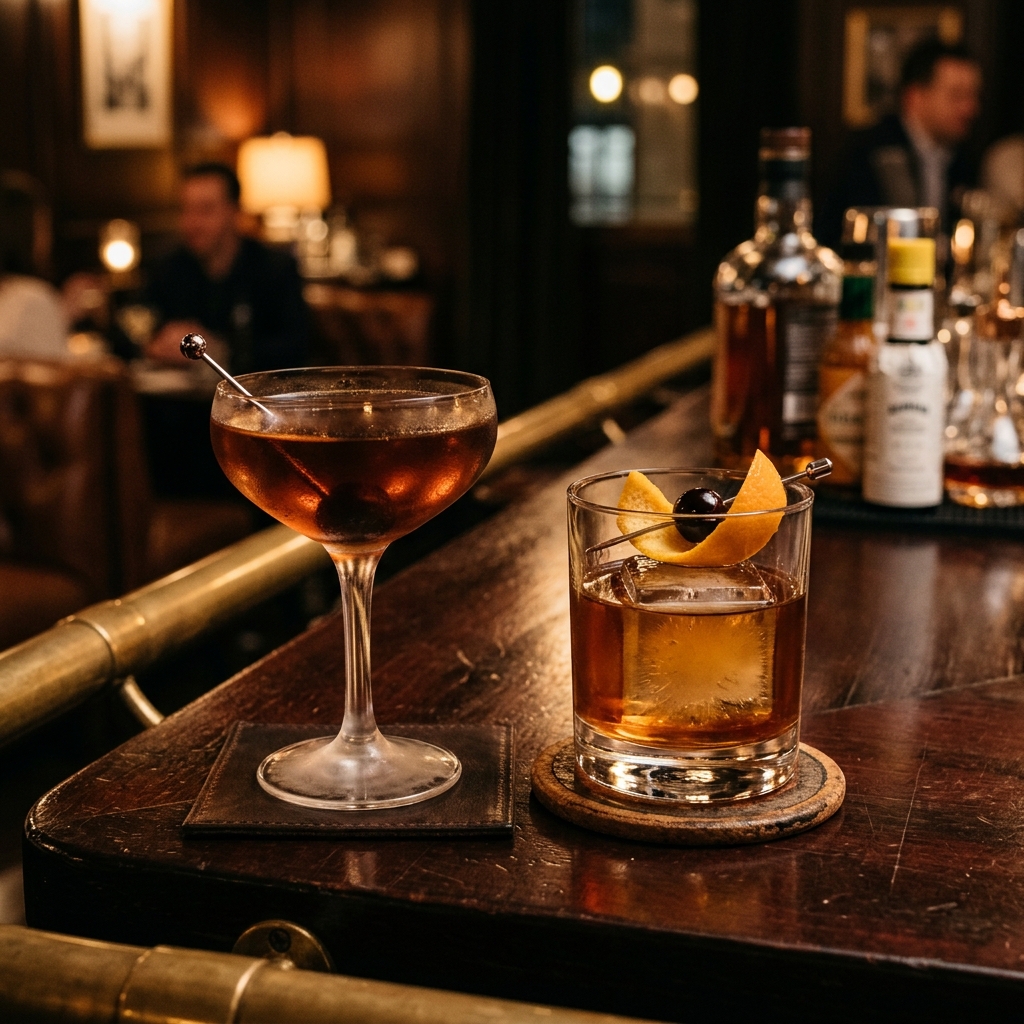
Comparing the manhattan vs old fashioned taste comes down to vermouth botanicals versus pure whiskey sweetness. A Manhattan delivers dark cherry, herbal wine notes served chilled up, while an Old Fashioned highlights warm oak, vanilla, and bright orange oils evolving over a dense ice cube.
Why Usual Advice Fails for Manhattan vs Old Fashioned Taste
Most bar guides tell readers that the Manhattan and the Old Fashioned are practically identical because both rely on American whiskey and aromatic bitters. This lazy comparison ruins the drinking experience for home hosts and cocktail enthusiasts alike. While they share historical roots from the nineteenth century, their flavor architectures, sugar chemistries, and mouthfeels occupy completely different worlds.
The first major mistake beginners make is misunderstanding perceived sweetness versus chemical sugar. Many drinkers assume an Old Fashioned is sweeter simply because it uses raw sugar or demerara syrup. In reality, a standard Manhattan contains more residual sugar per ounce due to the fortified sweet vermouth. Yet on the palate, a Manhattan tastes noticeably drier, darker, and more complex. The natural tartaric acids and bitter botanical herbs in the wine mask the sugar, creating an entirely different sensory impression.
Another critical failure point is ingredient handling, especially vermouth preservation. An Old Fashioned uses shelf-stable bitters and sugar syrup that keep their flavor for months at room temperature. Sweet vermouth, by contrast, is a fortified grape wine that oxidizes rapidly. When home bartenders pull a dusty bottle of sweet vermouth from an open liquor cabinet where it sat for six months, the resulting Manhattan tastes sour, vinegary, and flat. If you want to explore sweeter, muddled fruit styles popular across the Midwest, consult our comprehensive Wisconsin Old Fashioned guide to see how brandy and soda transform the classic formula.
I have spent over a decade designing home entertaining bars, hosting private dinner tastings, and experimenting with classic cocktail balance. To understand which drink suits your personal palate, you must evaluate how fortified wine acids react with oak tannins, how ice dilution alters aroma, and how glassware temperature changes every sip.
Flavor Profile Breakdown: Herbal Wine Notes vs Pure Whiskey Grain
When analyzing manhattan vs old fashioned taste, the foundational flavor difference lies in what modifies the primary spirit. In an Old Fashioned, the whiskey remains the undisputed star of the glass. The sugar and bitters exist purely to soften the fiery ethanol edge of the spirit, allowing natural barrel notes of caramel, toasted oak, baking spice, and vanilla to shine without competition.
A Manhattan, on the other hand, is a true synergistic collaboration between grain and grape. The introduction of sweet vermouth brings fortified red wine characteristics directly into the whiskey base. You taste rich stone fruits, stewed plums, dried figs, and bitter gentian roots. Instead of highlighting pure grain, the Manhattan transforms into a sophisticated, vinous aperitif with a silky, medium-bodied mouthfeel that coats the tongue.
Citrus expression also alters the immediate aroma. An Old Fashioned relies on freshly expressed orange peel oils sprayed over the rim of the glass. The airborne limonene oil provides a bright, zesty aroma that cuts through heavy bourbon corn sweetness. A Manhattan traditional build relies on Luxardo maraschino cherries and Angostura aromatics, creating a dark, brooding aroma profile dominated by clove, cinnamon, and spiced cherry.
| Sensory Factor | The Classic Manhattan | The Traditional Old Fashioned |
|---|---|---|
| Dominant Flavor Notes | Dark cherry, herbal wormwood, stewed plum, clove | Caramel, vanilla bean, charred oak, bright orange citrus |
| Sweetening Agent | Sweet Red Vermouth (Fortified wine with botanical infusion) | Rich Demerara Syrup (2:1 cane sugar to water) or Sugar Cube |
| Base Spirit Recommendation | Spicy 100-Proof Straight Rye Whiskey | Rich 90 to 100-Proof Kentucky Straight Bourbon Whiskey |
| Acidity Level | Moderate (pH 3.6 to 3.8 from grape tartaric acid) | Very Low (pH 5.2 to 5.6, minimal acid buffer) |
| Serving Style & Glassware | Served “Up” (Chilled and strained into a stemmed Coupe) | Served “On the Rocks” (Over a single dense 2-inch ice cube) |
| Dilution Dynamic | Static dilution (Fixed at point of initial stirring) | Dynamic dilution (Continuously softens and expands as ice melts) |
| Finish & Aftertaste | Lingering herbal bitterness, dry wine tannins, drying finish | Warm oak resonance, gentle molasses sweetness, citrus warmth |
When evaluating the manhattan vs old fashioned taste side by side, notice how each drink handles the palate finish. The Old Fashioned leaves a coating of warm vanilla and oak spice that feels cozy and direct. The Manhattan leaves a lingering, slightly bitter botanical dryness that cleanses the palate, making it far better suited as a pre-dinner cocktail before rich savory meals.
The Sweetness Paradox in Manhattan vs Old Fashioned Taste
One of the most fascinating aspects of cocktail sensory science is why people perceive an Old Fashioned as sweeter than a Manhattan despite scientific sugar measurements proving the opposite.
According to nutritional carbohydrate research from the U.S. Department of Agriculture FoodData Central database, natural grape fructose carries a different sweetness index than crystallized sucrose, reinforcing why vermouth and simple syrup create divergent palate sensations.
Sweet vermouth contains roughly 130 to 150 grams of residual sugar per liter, primarily in the form of natural grape fructose and glucose. When you pour a standard one-ounce measure of sweet vermouth into a Manhattan, you introduce approximately 4.0 to 4.5 grams of dissolved sugars into the glass. By comparison, an Old Fashioned made with one teaspoon (0.17 ounces) of rich 2:1 demerara simple syrup contains only 3.2 to 3.5 grams of sucrose.
Why then does the Old Fashioned taste distinctly sweeter to almost every taster? The answer comes down to two chemical components: acid and bitter botanicals. Sweet vermouth carries significant natural wine acidity, primarily tartaric and malic acids. Acid actively suppresses the perception of sweetness on human taste buds by stimulating salivary flow and balancing sucrose molecules. In addition, commercial sweet vermouths like Carpano Antica, Cocchi Storico, or Dolin Rouge are macerated with dozens of bitter roots, tree barks, and herbs, including wormwood, gentian, and cinchona bark. These bitter botanical compounds counter the sugar, leaving a dry, savory impression on the tongue.
| Vermouth Label | Region of Origin | Residual Sugar (g/L) | Signature Botanical Notes | Ideal Whiskey Pairing |
|---|---|---|---|---|
| Carpano Antica Formula | Turin, Italy | 160 g/L | Rich vanilla, stewed raisin, dark chocolate, bitter gentian | 100-Proof Straight Rye (Rittenhouse, Knob Creek Rye) |
| Cocchi Storico di Torino | Piedmont, Italy | 145 g/L | Dried orange peel, bitter cocoa, rhubarb, wormwood | High-Rye Bourbon (Four Roses Single Barrel, Bulleit) |
| Dolin Rouge | Chambéry, France | 130 g/L | Alpine herbs, wild berries, honey, light drying finish | Balanced 90-Proof Bourbon or Kentucky Straight Rye |
| Punt e Mes | Milan, Italy | 140 g/L | Intense orange peel, quina bark, pronounced amaro bitterness | Robust 101-Proof Wild Turkey Rye or Cask-Strength Whiskey |
When curating your home bar glassware and spirit collections, choosing the correct vermouth label dictates your finished cocktail balance. A heavier, vanilla-forward vermouth like Carpano Antica requires a bold, high-rye whiskey to avoid becoming cloying. Conversely, a lighter, alpine-style vermouth like Dolin Rouge harmonizes gently with delicate, wheat-forward bourbons.
Dilution Physics and Manhattan vs Old Fashioned Taste
The physical temperature and water content of a cocktail determine how aromatics escape the liquid and reach your olfactory receptors. A cocktail that is too warm tastes harsh and boozy; a cocktail that is over-diluted tastes watery and limp. According to the International Bartenders Association official cocktail standards, a traditional Manhattan mandates a strict 2:1 proportion of whiskey to sweet red vermouth, stirred over clean ice until properly chilled.
As documented in Difford’s Guide cocktail science research, stirring dense ice for thirty seconds achieves rapid chilling without exceeding twenty-five percent dilution, preserving volatile spirit aromatics. A Manhattan is stirred with dense ice in a mixing glass for 30 to 40 revolutions, achieving an optimal temperature of 30 to 32 degrees Fahrenheit (-1 to 0 degrees Celsius) and an initial water dilution of 22 to 25 percent. It is then strained directly into a stemmed glass, leaving the ice behind.

———————————————————————-
1. CLASSIC MANHATTAN (Served Up in a Stemmed Coupe):
– 2.0 oz Straight Rye Whiskey (50% ABV) = 1.00 oz alcohol
– 1.0 oz Sweet Red Vermouth (16% ABV) = 0.16 oz alcohol
– 2 Dashes Angostura Bitters (~0.05 oz at 44.7%) = 0.02 oz alcohol
– Pre-Stir Volume: 3.05 oz | Pure Alcohol Content = 1.18 oz
– Stirring Dilution (24% water added) = 0.73 oz water
– Final Serving Volume = 3.78 oz
FINAL SERVING ABV (1.18 oz / 3.78 oz) = 31.22% ABV (Static)
2. TRADITIONAL OLD FASHIONED (Served on 2-Inch Clear Cube):
– 2.0 oz Kentucky Straight Bourbon (45% ABV) = 0.90 oz alcohol
– 0.25 oz Rich Demerara Syrup (0% ABV) = 0.00 oz alcohol
– 3 Dashes Angostura Bitters (~0.075 oz at 44.7%) = 0.03 oz alcohol
– Pre-Stir Volume: 2.325 oz | Pure Alcohol = 0.93 oz
– Initial Stirring Dilution (16% water added) = 0.372 oz water
– Initial Pour Volume = 2.697 oz
INITIAL SERVING ABV (0.93 oz / 2.697 oz) = 34.48% ABV
– Melt Water Over 20 Minutes (+0.80 oz) = 3.497 oz final volume
FINAL SIPPED ABV (0.93 oz / 3.497 oz) = 26.59% ABV (Dynamic)
======================================================================
This mathematical difference explains why an Old Fashioned feels punchier on the first sip (34.48% ABV) but turns soft, gentle, and mellow (26.59% ABV) by the bottom of the glass. The Manhattan stays firm, assertive, and consistent from beginning to end.
Spirit Selection: Rye vs Bourbon and Proof Dynamics
The grain bill and alcohol proof of your whiskey make a profound impact on the finished cocktail. While you can technically make either drink with bourbon or rye, centuries of bartending tradition favor specific spirit pairings for sound chemical reasons.
A classic Manhattan requires straight rye whiskey. Rye grain contains high concentrations of phenolic compounds that deliver sharp black pepper, mint, clove, and dill flavors. When you mix rye with sweet vermouth, the spice of the rye cuts cleanly through the thick, viscous grape sugars of the wine. If you make a Manhattan with sweet, corn-heavy bourbon, the drink often turns syrupy, muddy, and cloying. For the best balance, choose a rye bottled between 95 and 100 proof, such as Rittenhouse Bottled-in-Bond, Wild Turkey 101 Rye, or Michter’s Single Barrel.
An Old Fashioned thrives on straight bourbon whiskey. Bourbon must be distilled from a mash bill of at least 51 percent corn and aged in charred new oak containers. The corn provides a naturally sweet baseline, while the charred oak barrels infuse the spirit with vanillin and lactones. Because an Old Fashioned uses only a small touch of simple syrup and bitters, the whiskey does not have to fight heavy wine botanicals. The warm caramel notes of bourbon meld naturally with the demerara sugar and orange oils. Excellent choices include Buffalo Trace, Elijah Craig Small Batch, or Woodford Reserve.
Setting up a dedicated drink-mixing station at home pairs naturally with practical space-saving layouts from our coffee bar ideas for small kitchens, keeping glassware and bottles within arm’s reach.
Ice, Glassware, and Aroma Delivery
Evaluating the manhattan vs old fashioned taste also depends on glassware, which is not merely aesthetic decoration but a functional tool that dictates how aroma vapors reach your nose and how heat transfers from your hands into the cocktail.
The Manhattan belongs in a stemmed glass: either an elegant curved Coupe or a classic V-shaped Nick & Nora glass. The long stem serves a critical thermal purpose. It prevents your body heat from warming the chilled liquid while you hold the drink. Stemmed glassware also exposes a wide surface area of the liquid to ambient air, allowing volatile floral and herbal vermouth aromas to concentrate right beneath your nostrils as you tilt the glass to sip.

The Old Fashioned requires a heavy, flat-bottomed lowball glass, historically known as a rocks glass or Old Fashioned tumbler. A premium rocks glass features thick, dense glass on the base that acts as an insulator, keeping the external tabletop warmth away from the melting ice. The wide, open cylindrical rim allows plenty of room for a single large ice cube while providing immediate access for your nose to capture expressed citrus oils sitting on the surface of the drink.
For home hosts interested in curating and retailing vintage glassware sets online, review our practical guide to launching a myshopify home decor store with safe shipping packaging.
Bitters and Citrus Oils: Angostura Aromatics vs Expressed Orange Peel
Bitters are the salt and pepper of the cocktail world. Without bitters, an Old Fashioned is simply cold sweetened whiskey, and a Manhattan is just watered-down whiskey vermouth punch. Both drinks rely primarily on Angostura aromatic bitters, yet they integrate botanical accents in distinctly different ways.
Angostura bitters contain a closely guarded blend of gentian root, allspice, cardamom, and clove macerated in high-proof neutral spirit. In a Manhattan, two dashes of Angostura integrate with the sweet vermouth, reinforcing the spiced clove and dark fruit characteristics of the wine. Many modern mixologists add one dash of orange bitters alongside the Angostura to provide a subtle citrus lift that cuts through heavy vermouth.
In an Old Fashioned, bitters play an active structural role in binding sugar to spirit. But the defining aromatic signature of an Old Fashioned is expressed orange peel. When you hold a fresh swatch of orange peel over the glass and snap it firmly between your thumbs, you burst the oil glands in the flavedo layer of the citrus skin. This action sprays a mist of limonene and citral oils over the surface of the cocktail. These aromatic oils hit your olfactory system before the liquid touches your lips, tricking your brain into anticipating sweetness while cutting through the heavy proof of the whiskey.
Claire Montgomery’s Sensory Evaluation Protocol
I evaluate classic whiskey cocktails using a disciplined four-stage sensory testing framework. When assessing flavor clarity between a Manhattan and an Old Fashioned, I follow this structured evaluation routine:
First, I measure residual dissolved sugar levels using a digital Brix refractometer. This test establishes the exact chemical sugar baseline of each drink independent of human taste bias. It consistently confirms that vermouth-based cocktails carry significantly more dissolved sugars than simple-syrup cocktails.
Second, I conduct a blind aroma assessment before taking a single sip. I hold each chilled glass one inch below nose level and take three gentle, shallow breaths. I look for alcohol vapor harshness versus aromatic nuance. A properly stirred cocktail will emit zero stinging ethanol fumes; instead, it presents clean notes of toasted oak, citrus zest, or herbal spice.
Third, I analyze the initial palate strike and mid-palate evolution. I take a small half-ounce sip and hold the liquid on the center of the tongue for three seconds before swallowing. I track whether the sweetness hits immediately at the tip of the tongue or emerges gradually along the sides of the palate through wine acidity.
Fourth, I monitor temperature and dilution decay over a twenty-five-minute window using an immersion digital probe thermometer. I record how flavor balance shifts as the cocktail warms from 32 degrees to 55 degrees Fahrenheit. This test verifies whether the drink remains balanced and enjoyable throughout an entire social conversation or falls apart as it approaches room temperature.
The Short Version: Key Takeaways for Choosing Your Cocktail
When deciding between these two timeless whiskey classics at a cocktail lounge or home bar cart, keep these core distinctions in mind:
- Flavor Profile: Choose the Manhattan if you want a sophisticated, herbal, vinous cocktail with dark cherry and wine complexity. Choose the Old Fashioned if you want a rich, whiskey-centric drink focused on oak, caramel, and bright orange zest.
- Sweetness Sensation: The Old Fashioned tastes sweeter and more rounded on the tongue due to unbuffered sugar syrup. The Manhattan contains more chemical sugar from vermouth, but tastes drier and more savory due to grape acidity and bitter herbs.
- Ice and Evolution: The Manhattan is served chilled without ice in a stemmed coupe, keeping its 31% ABV flavor balance completely stable. The Old Fashioned is served over a large ice sphere, evolving from a punchy 34% ABV down to a soft 26% ABV as you sip.
- Spirit Pairing: Match spicy 100-proof straight rye whiskey with sweet vermouth in a Manhattan. Match rich, caramel-forward Kentucky straight bourbon with simple syrup and bitters in an Old Fashioned.
- Serving Occasion: The Manhattan serves as a fantastic aperitif before dinner because its herbal vermouth stimulates appetite. The Old Fashioned shines as a slow-sipping nightcap or cozy fireside cocktail.
Frequently Asked Questions About Manhattan vs Old Fashioned Taste
Which cocktail is stronger, a Manhattan or an Old Fashioned?
When freshly poured, an Old Fashioned is slightly stronger at roughly 34.5% ABV, compared to a Manhattan at approximately 31.2% ABV. This difference occurs because an Old Fashioned uses only a tiny splash of simple syrup, whereas a Manhattan incorporates lower-proof fortified wine (sweet vermouth at 16% ABV). However, as the large ice cube in an Old Fashioned melts over twenty minutes, its strength gradually drops to around 26.5% ABV, while the iceless Manhattan remains at its initial strength until finished.
Why does a Manhattan taste less sweet than an Old Fashioned?
A Manhattan tastes less sweet because sweet vermouth contains natural tartaric and malic fruit acids, along with bitter botanical herbs like wormwood and gentian. These acidic and bitter compounds suppress your tongue’s perception of sweetness. An Old Fashioned contains pure sugar syrup with zero acid, allowing the sweetness to register directly and forcefully on your taste buds without any botanical interference.
Can I order an Old Fashioned made with rye whiskey instead of bourbon?
Yes, ordering an Old Fashioned with rye whiskey is a traditional and highly respected choice. Rye whiskey introduces bold baking spices, cracked black pepper, and mint notes that counteract the sweetness of the sugar syrup, creating a crisp, drier profile than a corn-sweetened bourbon Old Fashioned. If you prefer less sweetness and more spirit punch, a 100-proof rye Old Fashioned is an outstanding option.
Why should sweet vermouth always be kept in the refrigerator?
Sweet vermouth is a fortified wine, not a distilled spirit. Once exposed to oxygen, the natural grape compounds oxidize, turning the liquid sour, stale, and vinegar-like within a month at room temperature. Keeping sweet vermouth tightly sealed in the refrigerator slows oxidation significantly, preserving its fresh herbal aromatics for up to eight weeks. Never make a Manhattan with a vermouth bottle that has been sitting open on a warm liquor shelf.
What is the purpose of expressing an orange peel over an Old Fashioned?
Expressing an orange peel sprays microscopic droplets of volatile citrus oil (limonene) directly across the surface of the drink and onto the rim of the glass. These citrus oils create an invigorating aroma that reaches your olfactory senses before the liquid enters your mouth. This bright citrus aroma balances the heavy ethanol vapors of high-proof whiskey and complements the warm oak tannins of the bourbon.


2 Comments