If you have ever tried to follow along with an advanced pilates workout on YouTube, you probably spent the entire twenty minutes feeling completely lost, out of breath, and wondering if you were doing anything right. The movements often look deceptively simple, but when executed correctly, they are incredibly demanding. If you are brand new to the practice, jumping straight into advanced choreography is a recipe for neck pain and extreme frustration.
What you actually need is a true beginner mat pilates class. You need to strip the movements back to their absolute basics and learn how to actually engage your deep core muscles rather than just throwing your limbs around.
Here is a comprehensive breakdown of how to start your practice at home safely, effectively, and without feeling completely overwhelmed.
The golden rule: breath and core engagement
Before you even think about lifting a leg or rolling up off the mat, you have to understand the pilates breath. In traditional weightlifting, you might hold your breath during a heavy exertion. In pilates, your breath is the engine that drives every single movement.
You should inhale deeply through your nose, expanding your ribcage laterally (out to the sides) rather than letting your belly pooch out. When you exhale, you force the air out through your mouth like you are blowing through a tiny straw. As you exhale, imagine a tight corset wrapping around your waist, pulling your belly button down toward your spine. This specific breathing technique automatically engages your transverse abdominis, which is the deepest layer of your core muscles.
If you spend your first week just practicing this lateral breathing while lying flat on your back, you are already doing pilates.
If you struggle to find the mind-muscle connection during these slow movements, incorporating spiritual self care routines like meditation before your workout can help ground you and improve your focus.
READ ALSO: The Ultimate Sunday Reset Routine Checklist for the Sunday Scaries
Finding neutral spine
In a beginner mat pilates class, the instructor will constantly cue you to find your “neutral spine” or to “imprint” your spine. Understanding the difference between these two positions is crucial for protecting your lower back.
- **Neutral Spine:** When you lie flat on your back with your knees bent and feet flat on the floor, there should be a tiny, natural curve in your lower back. You should be able to slide a few fingers under your lumbar spine. This is your neutral position, and it is where you want to be for most exercises when both feet are on the floor.
- **Imprinted Spine:** When you lift your legs up into the air (a position called “tabletop”), the weight of your legs will naturally cause your lower back to arch heavily. To prevent back pain, you must “imprint” your spine by slightly tilting your pelvis backward and pressing your lower back firmly into the mat.
If you feel pain in your lower back during an abdominal exercise, it means you have lost your core engagement and your spine has arched. Stop, reset your imprint, and try again.
The 3 foundational exercises for beginners
Once you have mastered the breath and the spine positions, you can move on to the actual exercises. These three movements form the foundation of almost every mat pilates class.
1. The Hundred
This is the classic pilates warm-up. Lie on your back, imprint your spine, and bring your legs into a tabletop position (knees bent at 90 degrees). Curl your head, neck, and shoulders off the mat. Reach your arms straight down by your sides, hovering a few inches off the floor. Now, pump your arms vigorously up and down while inhaling for five counts and exhaling for five counts. Repeat this ten times until you hit one hundred pumps.
2. The Half Roll-Back
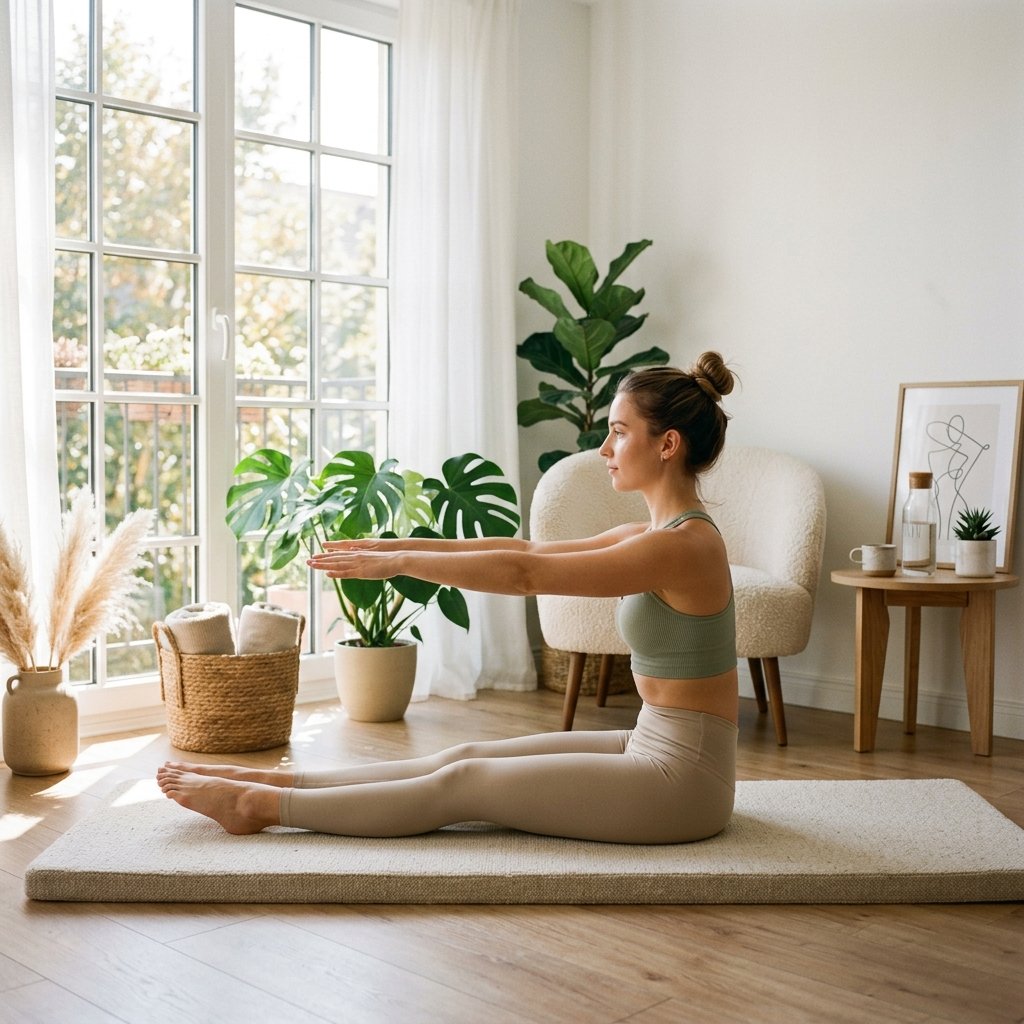
This teaches you spinal articulation. Sit up tall with your knees bent and feet flat on the floor. Reach your arms straight out in front of you. Inhale to prepare. As you exhale, scoop your belly button in, tuck your tailbone, and slowly roll your spine backward halfway to the floor, creating a C-curve with your spine. Inhale and hold. Exhale to slowly articulate your spine back up to a seated position.
3. Single Leg Circles
This exercise builds core stability while improving hip mobility. Lie flat on your back with your neutral spine. Extend one leg straight up toward the ceiling (or keep a slight bend in the knee if your hamstrings are tight). Keep your pelvis perfectly still—do not let your hips rock side to side. Draw a small circle on the ceiling with your toe, inhaling for half the circle and exhaling for the other half. Do five circles in one direction, then reverse.
If you are looking for structured video guidance, Byrdie has curated a fantastic list of the best online pilates platforms that offer dedicated beginner series to help you perfect your form.