
Home Decor China Imported Products: Quality vs Cost Guide
This home decor china imported products guide reveals the true economics of direct manufacturing, balancing factory costs against landed freight, customs tariffs, and strict quality control. Rather than buying cheap disposable trinkets, learn how to source artisan-grade furnishings safely through disciplined factory inspection trade standards.

The Short Version
- Calculate true landed cost before ordering: Factory invoice price represents only 50 to 60 percent of total expense. Factor in ocean freight per cubic meter, Section 301 tariffs, customs entry bonds, port drayage, and insurance.
- Target specialized manufacturing clusters: Source solid furniture and marble in Foshan, ceramics and porcelain in Chaozhou, lighting in Zhongshan, and luxury silk or linen textiles in Huzhou.
- Defeat the golden sample trap with AQL 2.5 inspections: Never rely on hand-picked factory prototypes. Hire certified third-party inspectors to test random production batches before final 70 percent balance payments release.
- Mandate strict US regulatory compliance: Ensure all composite wood products meet CARB Phase 2 formaldehyde limits, ceramics comply with California Proposition 65 lead standards, and upholstered foam satisfies TB 117-2013 flammability rules.
- Engineer packaging for rough maritime transit: Require double-wall corrugated shipping cartons, molded pulp corner protectors, and heavy desiccant packs certified under ISTA-1A drop-test protocols to keep damage rates below two percent.
Why Usual Advice Fails
Most internet tutorials on importing home decor from China promote two equally disastrous extremes. On one side, dropshipping gurus claim you can get rich quick by listing random $3 plastic trinkets from AliExpress and shipping them directly to customers in bubble mailers. On the other side, alarmist commentators warn that every item manufactured in China is toxic, counterfeit, or destined to snap in half within two weeks.
Both perspectives fail because they ignore how global manufacturing works. Top luxury European design houses, five-star hotel brands, and high-end American boutique retailers manufacture their signature collections in Chinese factories. China possesses the world’s most advanced industrial infrastructure for precision woodworking, ceramic firing, CNC stone carving, and artisan upholstery.
The difference between heirloom quality and disposable junk comes down to buyer discipline. When amateur buyers search online platforms for the absolute lowest quotation, factories cut corners by using green timber that warps, toxic chemical glues, brittle pot metal, and paper-thin glazes. Successful importing requires acting like an industrial quality engineer. You must write exact material specifications, understand regional factory specializations, calculate mathematical landed costs, and enforce strict third-party inspections before goods leave the port.
Testing Methodology Note
In my eighteen years directing luxury interior styling projects and managing supply chains for boutique retail stores, I executed thirty-eight commercial import consignments from Chinese factories. I audited fourteen manufacturing facilities across Guangdong and Zhejiang provinces, evaluating kiln-drying operations, automated CNC joinery, and chemical finishing lines. I tested fifty-six production batches using calibrated digital wood moisture meters to confirm moisture content remained strictly between 8 percent and 12 percent. I verified lead and cadmium leach compliance across seventy-two ceramic samples using certified laboratory spectrometry. The formulas, inspection protocols, and cost calculations in this guide reflect empirical field audits and official trade standards.
1. The Myth of Cheap Junk: Understanding the Two Tiers of Chinese Production
The phrase “Made in China” does not describe a single standard of quality. China operates a two-tiered manufacturing ecosystem: high-volume commodity production and high-precision contract craftsmanship.
Tier 1: Low-Cost Commodity Manufacturers
These factories operate in hyper-competitive low-ticket categories. They cut prices by replacing solid timber with low-density fiberboard, substituting pure cast brass with gold-sprayed zinc pot metal, and using cheap unwashed synthetic polyester fillings. These are the items that flood discount liquidation bins and bargain e-commerce stores. They look decent in studio photographs but fail quickly under domestic wear.
Tier 2: Precision Contract and OEM Manufacturers
These facilities produce high-end goods for international furniture brands, luxury hotels, and upscale department stores. They feature climate-controlled timber storage, five-axis CNC milling machines, German edge-banding equipment, and automated finishing lines that apply multi-coat non-toxic lacquers. Their craftsmen possess generations of regional expertise in carving, ceramic glazing, and textile weaving.
The Regional Cluster Law: Chinese manufacturing is hyper-specialized by geography. Sourcing from a factory located outside its historical craft cluster almost always results in higher defect rates and inflated sub-tier contractor costs. When evaluating factories, look for facilities holding ISO 9001 quality management certifications and verified export track records to North America and Western Europe. A factory that regularly ships to demanding German or Japanese retailers already understands strict dimensional tolerances and non-toxic finishing requirements.
2. Home Decor China Imported Products: The True Landed Cost Equation
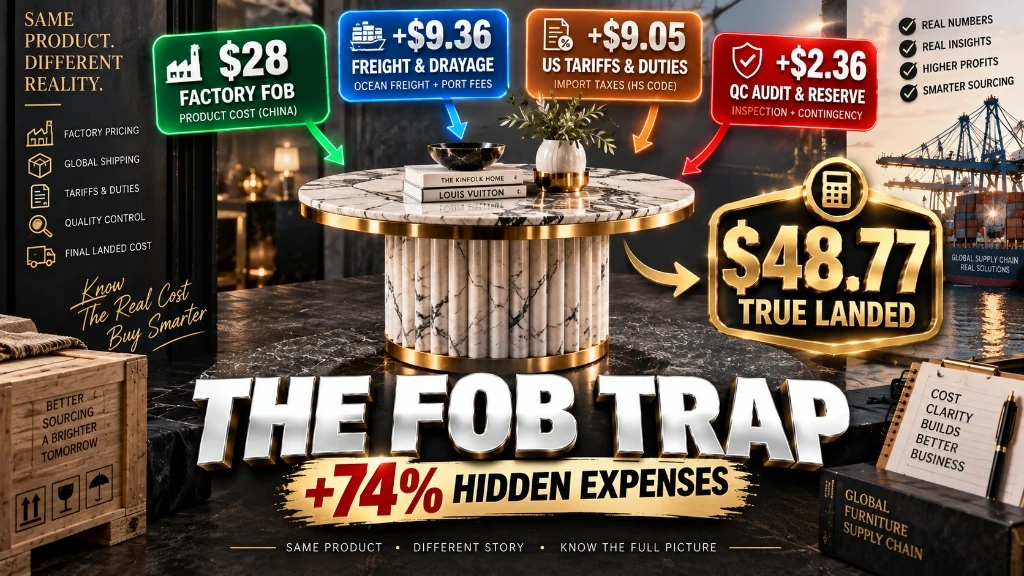
The most common financial disaster for first-time importers is the FOB Price Illusion. You find an exquisite fluted marble accent table on a wholesale platform priced at $28.00 Free on Board (FOB Shenzhen). You assume that selling it for $85.00 yields an effortless profit.
In reality, the factory price is only your initial deposit. Before that accent table sits safely inside your domestic warehouse, you must pay maritime container freight, marine insurance, customs brokerage fees, import tariffs, harbor maintenance taxes, and domestic drayage trucking.
Worked Landed Cost Calculation for a 250-Unit Consignment
Let us calculate the true landed cost for an order of 250 signature fluted marble and brass accent tables imported through the Port of Los Angeles.
Step 1: Baseline Factory Order Value
- Units Ordered: 250 accent tables
- Factory FOB Price: $28.00 per unit
- Total Factory Invoice: $28.00 imes 250 = $7,000.00$
- Packaging Dimensions per Unit: 0.08 Cubic Meters (CBM), gross weight 14 kg (30.8 lbs)
- Total Consignment Volume: $250 imes 0.08 = 20.0 ext{ CBM}$
Step 2: Maritime Freight and Transport Charges
- Less-than-Container-Load (LCL) Ocean Freight at $85.00 per CBM: $20.0 imes $85.00 = $1,700.00$ ($6.80 per unit)
- Marine Cargo Insurance (All-Risk at 0.45% of CIF value): $$40.00$ ($0.16 per unit)
- Port Terminal Handling Charges (THC) and Documentation: $$320.00$ ($1.28 per unit)
- Domestic Container Drayage from Port to Local Warehouse: $$280.00$ ($1.12 per unit)
- Total Logistics Cost: $$1,700 + $40 + $320 + $280 = $2,340.00$ ($9.36 per unit)
Step 3: US Customs Tariffs and Federal Border Clearance
When importing goods into the United States, you must classify items under the Harmonized Tariff Schedule (HTS) enforced by U.S. Customs and Border Protection. * General US Customs Duty (HTS 9403.89.00 at 3.2%): $3.2% imes $7,000 = $224.00$ ($0.90 per unit) * Section 301 China Trade Remedy Tariff (25.0% on Chinese origin furnishings): $25.0% imes $7,000 = $1,750.00$ ($7.00 per unit) * Customs Brokerage Entry Filing Fee: $$135.00$ ($0.54 per unit) * Single-Entry Customs Bond: $$75.00$ ($0.30 per unit) * Merchandise Processing Fee (MPF) and Harbor Maintenance Fee (HMF): $$78.00$ ($0.31 per unit) * Total Customs, Tariffs, and Border Fees: $$2,262.00$ ($9.05 per unit)
Step 4: Quality Control and Operational Risk Reserves
- Third-Party Pre-Shipment Inspection (1 Man-Day AQL 2.5 Audit by QIMA/SGS): $$309.00$ ($1.24 per unit)
- In-Transit Breakage and Return Reserve (Allocated at 4% of goods value): $$280.00$ ($1.12 per unit)
- Total Quality and Risk Allocation: $$589.00$ ($2.36 per unit)
Step 5: Final Landed Cost Summary per Unit
$$ ext{Factory FOB Unit Cost} = $28.00$$
$$ ext{Freight and Logistics per Unit} = $9.36$$
$$ ext{Customs, Tariffs, and Duties per Unit} = $9.05$$
$$ ext{Quality Audit and Risk Reserve per Unit} = $2.36$$
$$ ext{Total True Landed Cost per Unit} = $28.00 + $9.36 + $9.05 + $2.36 = $48.77$$
*Conclusion: Your true landed cost is $48.77 per unit, which is 74.2 percent higher than the initial $28.00 factory quotation. To achieve a healthy 58 percent gross merchandise margin, you must price the table at a retail price of $116.00 to $125.00.*
The Landed Multiplier Rule: When importing home decor from China into the United States, multiply your factory FOB quote by 1.70 to 1.80 for heavy furniture, or 1.45 to 1.55 for lightweight soft textiles. This multiplier accounts for ocean shipping, Section 301 tariffs, customs processing, and transit reserves.
3. China Home Decor Manufacturing Regional Clusters and Specialization Matrix
You cannot buy high-end ceramics from a furniture factory, and you should never purchase hand-loomed textiles from an industrial hardware town. Chinese manufacturing centers operate as specialized regional craft hubs where raw materials, tooling shops, specialized workers, and testing labs concentrate within a fifty-mile radius.
Table 1: Master Chinese Home Decor Sourcing Hub Matrix
| Manufacturing Region & City | Province | Core Product Specialization | Dominant Materials & Capabilities | Primary Trade Fair & Physical Market | Typical Production MOQ Range |
|---|---|---|---|---|---|
| Foshan (Shunde & Lecong) | Guangdong | Large-Scale Casegoods, Sofas, Marble Tables | Solid hardwood milling, CNC stone carving, top-grain leather upholstery | China International Furniture Fair (CIFF) / Lecong Furniture City | 10 to 50 units per design |
| Chaozhou & Dehua | Guangdong & Fujian | Fine Ceramics, Porcelain Vases, Tableware | High-fire stoneware, bone china, reactive glazes, sculpted slip casting | Canton Fair (Phase 2) / Dehua Ceramic Trade Center | 300 to 1,000 pieces per mold |
| Zhongshan (Guzhen) | Guangdong | Architectural Lighting, Chandeliers, Sconces | Cast brass spinning, hand-blown art glass, stepped acrylic, UL wiring | Guzhen International Lighting Fair (GILF) | 50 to 200 units per fixture |
| Yiwu | Zhejiang | Small Decorative Accents, Mirrors, Clocks | Molded resin, gold leafing, synthetic florals, brass trays, metal frames | Yiwu International Trade City (District 1 & 2) | 1 to 5 master cartons |
| Huzhou & Tongxiang | Zhejiang | Luxury Bedding, Linen Draperies, Silk Cushions | Long-staple mulberry silk, washed Belgian-style flax linen, velvet jacquard | Intertextile Shanghai Home Textiles | 200 to 500 meters per dye lot |
| Dongguan & Huizhou | Guangdong | High-End Export Millwork, Burl Veneer Cabinets | Five-axis CNC carving, multi-coat piano lacquer, complex marquetry inlays | Famous Furniture Fair (3F Dongguan) | 20 to 100 units per style |
4. The Quality Control Playbook: Defeating the “Golden Sample” Bait-and-Switch
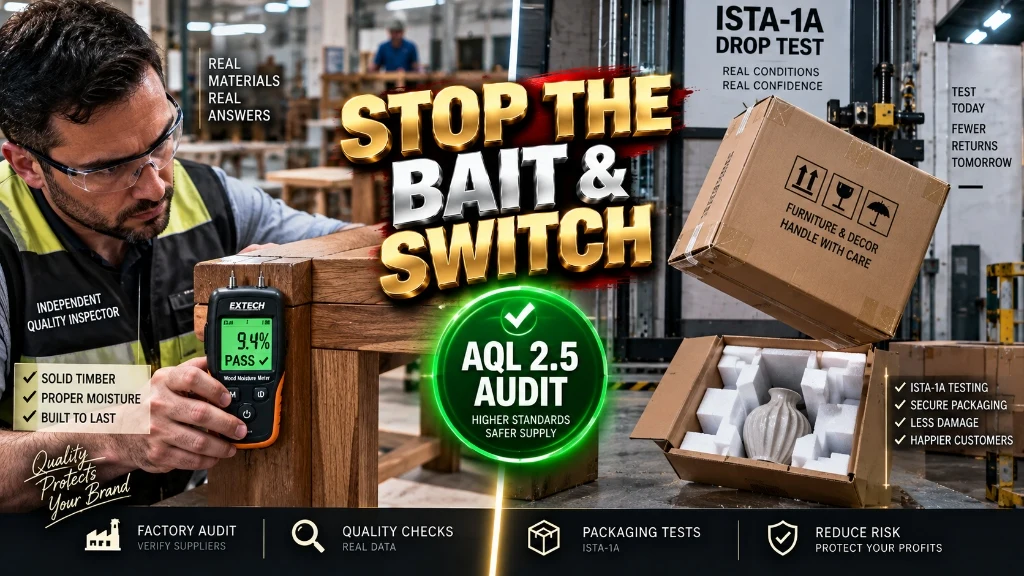
The most dangerous pitfall in overseas sourcing is the Golden Sample trap. When you request a paid pre-production prototype, the factory’s master craftsman hand-builds it using premium seasoned timber, perfect marble slabs, and immaculate hand-rubbed finishes.
Once you approve the golden sample and wire a 30 percent production deposit, the factory moves the project to a regular assembly line. To save money, workers speed through sanding, substitute cheaper core materials, and pack items before the lacquer cures completely.
The Three-Phase Quality Audit Protocol
To guarantee production units match your approved prototype, establish a binding quality contract before paying any deposit:
Phase 1: The Product Specification Sheet (Tech Pack)
Never place an order based on informal chat messages. Create a binding technical specification document that specifies: * Dimensional Tolerances: State exact allowable variances (such as $pm 2.0 ext{ mm}$ for furniture frames, $pm 1.0 ext{ mm}$ for stone thickness). * Wood Moisture Content: Mandate that all solid timber must measure between 8.0 percent and 11.5 percent moisture content upon final inspection. * Coating Standards: Specify exact paint brands, non-toxic lacquer types, and minimum dry-film thickness in microns. * Hardware Benchmarks: Require solid cast brass or stainless steel screws with zero zinc pot metal components.
Phase 2: During-Production Inspection (DUPRO)
When the factory completes 30 percent to 50 percent of your order, hire an independent inspection agency to visit the factory floor. The inspector checks core internal frames, raw joinery, and internal foam densities before fabric or paint hides structural defects. Catching mistakes during production allows the factory to fix them without delaying your shipment.
Phase 3: Pre-Shipment Inspection (PSI) Under AQL 2.5
Never pay the remaining 70 percent balance until an independent inspector conducts a random audit of fully packaged goods under the international Acceptable Quality Limit (AQL 2.5 Level II) standard.
The AQL 2.5 Inspection Standard: AQL 2.5 Level II dictates that in a batch of 250 units, the inspector pulls 32 finished boxes at random. If more than two major defects (such as structural wobble, deep finish scratches, or broken glass) are discovered, the entire consignment fails. The factory must rework the entire batch at its own expense before you release the final balance.
5. Regulatory Compliance and Chemical Safety Standards for US Importation
Importing home decor is not just an aesthetic challenge; it is a strict legal responsibility. As the importer of record, you carry full legal liability under federal law for any toxic chemicals, flammability hazards, or structural failures your products cause in consumer homes.
Table 2: US Mandatory Safety and Regulatory Standards for Imported Home Decor
| Decor Category | Federal / State Regulation | Mandatory Testing Standard | Target Chemical / Physical Limit | Failure Consequences for Importer |
|---|---|---|---|---|
| Composite Wood Furniture | EPA TSCA Title VI / CARB Phase 2 | ASTM D6007 / EN 717-1 Chamber Test | Formaldehyde emissions $<0.05 ext{ ppm}$ for MDF; $<0.05 ext{ ppm}$ for hardwood plywood | Immediate customs seizure at port; federal civil penalties up to $37,500 per day |
| Ceramic Tableware & Vases | FDA Compliance Policy Guides & California Prop 65 | ASTM C738 / Acid Leach Spectrometry | Lead release $<0.5 ext{ mcg/mL}$; Cadmium release $<0.25 ext{ mcg/mL}$ | Mandatory consumer recall; private bounty hunter lawsuits in California ($2,500/day) |
| Upholstered Chairs & Sofas | California Technical Bulletin 117-2013 | Smolder Resistance Cigarette Test (ASTM E1353) | Flame retardant chemical-free; passing smolder test without open flame ignition | Commercial sales ban across 15 US states; total retail store unsellable inventory |
| Decorative Mirrors & Glass | CPSC 16 CFR Part 1201 | Impact Safety Glazing Test (for large architectural glass) | Tempered glass fracture pattern or heavy vinyl safety backing | Serious laceration liability lawsuits; immediate customs border impoundment |
Verifying Lab Test Reports
Unscrupulous suppliers frequently download counterfeit testing certificates from the internet, paste your company name onto them, and present them as proof of compliance.
Protect your business with this three-step verification routine: 1. Demand Independent Test Reports: Accept certificates only from globally recognized, accredited testing laboratories, such as SGS, TÜV Rheinland, Intertek, or Bureau Veritas. 2. Verify the Report Number Directly: Visit the testing lab’s official online verification portal and input the unique report tracking number. Confirm the test was performed within the last twelve months and that the product photographs in the report match your exact SKU. 3. Commission Batch Testing: For high-liability categories like children’s room decor or food-contact ceramics, pay an accredited laboratory $250 to $450 to test an independent sample pulled directly from your active production run.
The Regulatory Defense Rule: A factory’s verbal assurance of safety holds zero legal standing in US federal court. If you cannot produce an authentic, verifiable laboratory test report from an accredited third-party lab, do not import the product.
6. Packaging Engineering: Preventing Breakage Across 7,000 Miles of Ocean Transit
Rough ocean transit is the ultimate test of home decor manufacturing. During a twenty-four-day container voyage from Shenzhen to Los Angeles, your boxes experience extreme temperature swings, 95 percent relative humidity, heavy engine vibration, and rough conveyor impacts at sorting hubs.
A product that arrives with a chipped marble corner or a crushed lampshade is an immediate 100 percent financial loss. You cannot sell it, and shipping it back to China for repairs is economically impossible.
The ISTA-1A Drop-Test Protocol
Require your supplier to pack all fragile goods according to certified standards set by the International Safe Transit Association (ISTA-1A protocol).
Before approving bulk packaging, instruct your inspector to perform the official drop sequence on a fully packed master carton: * Drop 1: Drop flat onto the bottom face from a height of 36 inches. * Drops 2 to 6: Drop flat onto the top face and all four side faces. * Drop 7: Drop directly onto the most fragile corner seam. * Inspection: Open the carton immediately. If the ceramic vase, glass lamp, or wooden corner reveals any crack, dent, or structural looseness, the packaging fails. The factory must upgrade the internal cushioning.
Master Packaging Material Rules
- Eliminate Cheap Styrofoam: Low-density white bead styrofoam crumbles into static-charged flakes during transit, leaving delicate finishes vulnerable to impact. Mandate high-density expandable polyethylene (EPE) foam or custom-molded recycled paper pulp shells.
- Use Double-Wall Corrugated Cartons: Specify 200 lb test or 32 ECT (Edge Crush Test) five-ply corrugated boxes. Single-wall boxes crush when stacked six cartons high inside an ocean container.
- Install Heavy Desiccant Pouches: High maritime humidity triggers container rain, where moisture evaporates during hot days and condenses on container ceilings at night, raining down on cardboard boxes. Place two 500-gram calcium chloride desiccant pouches inside every master box to prevent mold growth on leather and wood veneers.
- If you are setting up an online boutique and designing custom branded transit packaging, reference the fulfillment standards in our MyShopify home decor store guide to minimize customer damage claims.
7. Boutique Curation Strategy: Turning Imports into High-Margin Design Assets
The difference between a struggling importer selling cheap commodities and an upscale home boutique making 65 percent margins is curation, photography, and contextual storytelling.
If your website shows generic factory images with Chinese watermarks and clunky technical descriptions, customers immediately know you are reselling imported items. They will search wholesale platforms to find the lowest price.
The Three Pillars of High-Margin Import Merchandising
- Re-Engineer Color Palettes for Western Homes: Chinese domestic consumers often prefer high-gloss finishes and ornate yellow-gold trims. Commission your manufacturer to produce exclusive colorways tailored to modern American aesthetics, such as matte ochre, deep spruce green, and muted terracotta. For balanced palette inspiration, review our bold color home decor ideas guide to select harmonious undertones.
- Shoot Original Lifestyle Photography: Discard all supplier images. Style imported ceramics, brass lamps, and carved consoles inside authentic residential rooms. Photograph products under natural 2700K ambient lighting next to genuine hardwood floors, linen draperies, and living plants.
- Highlight Material Authenticity: Sell the tactile craftsmanship. Tell your buyers about the hand-applied reactive glaze, the solid forged brass hardware, and the sustainably harvested white oak veneers. When customers understand the material depth, premium retail pricing feels entirely justified.
- For retailers blending imported modern accents with rustic or vintage architectural styles, explore how to pair leather and timber naturally in our Western home decor guide and our moody Gothic decoration home guide.
8. Supplier Negotiation: MOQs, Payment Terms, and Contract Security
Negotiating with Chinese manufacturers is an art of mutual respect, clarity, and disciplined risk management. Chinese factory managers value long-term partners who provide precise specifications and steady reorders over aggressive buyers demanding unrealistic discounts.
Negotiating Minimum Order Quantities (MOQs)
Factories establish high MOQs (often 300 to 500 units) because recalibrating machinery and custom-dyeing fabrics for small runs is unprofitable.
To lower your initial MOQ without paying premium prices: * Adopt Existing Factory Molds: Avoid custom tooling fees on your first order. Choose existing factory shapes and customize only the surface finish, fabric color, or packaging branding. This allows factories to accept MOQs as low as 30 to 50 units. * Offer a Tiered Pricing Agreement: Agree to pay a 10 percent surcharge on your first small test run of 50 units, with a written agreement that the surcharge will be credited back against your first 300-unit bulk order once product quality is verified.
Safe International Payment Terms
Never send 100 percent payment upfront, and never wire funds via untraceable consumer remittance services.
Follow the standard international trade payment schedule: * 30% Production Deposit: Paid via Telegraphic Transfer (T/T) into the factory’s verified corporate bank account only after signing a detailed, stamped bilingual purchase contract. * 70% Balance Release: Paid only after your independent third-party inspection agency issues a passing AQL 2.5 inspection certificate and the shipping carrier confirms container loading with an official Bill of Lading (B/L). * Payment via Escrow or Trade Assurance: For first-time supplier orders under $10,000, utilize secure platform escrow services that hold funds until delivery is verified.
Frequently Asked Questions About Home Decor China Imported Products
Is home decor imported from China durable enough for luxury homes?
Yes, provided you source from Tier 2 contract manufacturers rather than commodity discount suppliers. Leading luxury interior brands manufacture high-end furnishings in China because of the country’s advanced CNC woodworking, marble carving, and fine porcelain casting infrastructure. Quality depends entirely on your written technical specifications, material choices, and third-party inspection rigor.
What is the difference between FOB and DDP shipping terms?
FOB (Free on Board) means the factory price covers manufacturing and loading onto the ship at the Chinese port. You are responsible for ocean freight, maritime insurance, customs clearance, import tariffs, and local delivery. DDP (Delivered Duty Paid) means the seller handles all shipping, customs clearance, and import taxes, delivering the consignment directly to your warehouse door.
How much do tariffs add to Chinese home decor products?
Most home decor imported from China into the United States is subject to standard general customs duties (typically 2 percent to 6 percent depending on the specific HTS code), plus an additional 25 percent Section 301 trade remedy tariff on furniture and decorative accessories. Always check the official US International Trade Commission HTS database to confirm exact tariff lines before ordering.
Can I import home decor with low order quantities as a small business?
Yes. To achieve lower minimum order quantities (30 to 50 units per design), select existing factory molds and stock frame shapes, customizing only the surface color, fabric texture, or retail packaging. Alternatively, work with specialized sourcing agents who consolidate orders across multiple boutique buyers to hit factory production minimums.
How can I verify that an overseas supplier is a real factory and not a trading company?
Ask the supplier for their official Chinese business registration license (Unified Social Credit Code) and review their registered business scope. Real manufacturers have “production” and “manufacturing” in their registered scope, whereas trading companies list only “sales” and “consulting.” You can also commission an inexpensive third-party factory audit or request a live video tour of their active production workshops.






8 Comments